No childhood rows of corn. No inherited land. No grandpa in overalls with a loyal farm dog named Dusty.
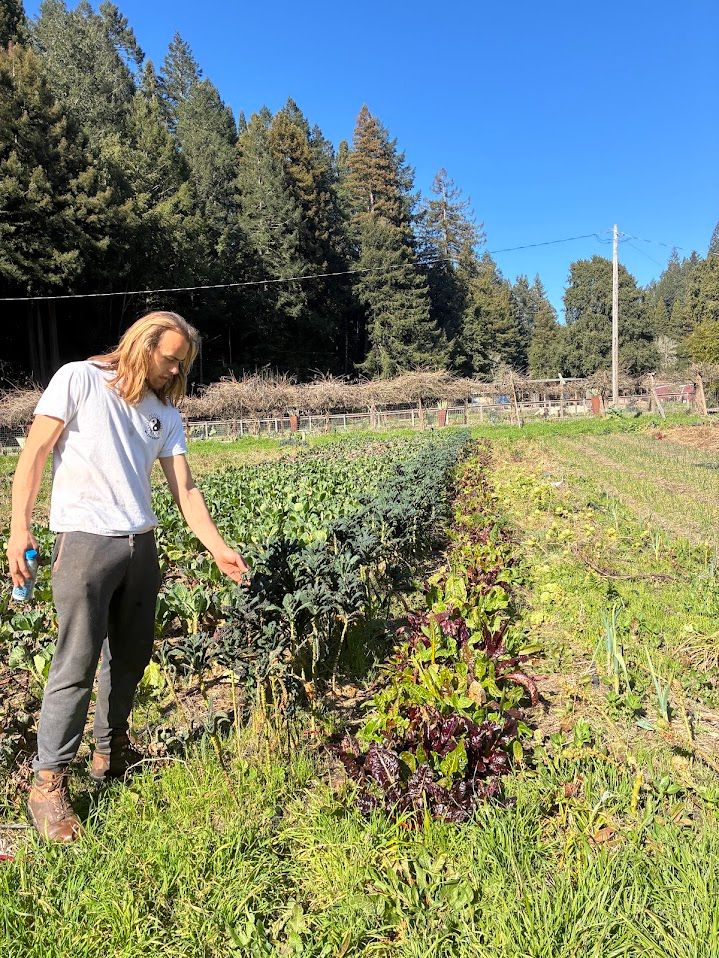
Cameron learned farming the way most people learn things now: late-night YouTube, a small patch of dirt, and the kind of hobby that starts as “this is cute” and quietly turns into “oh… farming’s like my whole personality now.” That kind of accidental obsession feels at home in this part of Sonoma County, which is probably why the drive to meet him makes so much sense.
To get there you pass through Guerneville, a town that feels mid-transition, where the majestic and the messy share a sidewalk. First the deep shade of Armstrong Redwoods, the forest that first convinced me I could actually live here. Then the town: thrift stores, rainbow flags, old river motels, and people who look like they arrived last week or never left. Hippies, wanderers, locals and the unhoused blur together in a way that is complicated and oddly honest. Some people come here to find freedom. Others drift and stay because the river makes leaving feel optional.
I stop at Coffee Bazaar, the small place beside the bookstore where everything is slow on purpose — people reading, quiet conversations, nobody pushing you out the door. No one is dressed for a casting call, no one is pitching a screenplay mid-latte, and no barista is glaring at my outfit while explaining an aggressively overpriced coffee. A few minutes downriver, Northern California gets even more Northern California: there is a skate park in the middle of the redwoods, next to Lightwave Café. At some point a group of adults approved this plan. My Pakistani parents would be deeply confused.
Somewhere along this stretch of river, a young farmer is building a life from scratch. I first noticed 26-year-old Cameron Lilly through my climate action networks, and then at his farmers’ market stall in Santa Rosa, where he stood behind his produce with a bucket of wildflower bouquets he’d grown himself.
We meet in the afternoon on a bright, clean day, the kind of California winter day that feels like you got away with something. The beds are narrow and long, lined up like sentences; tarps cover sections like punctuation. My dog Luka circles the rows, verifying the dirt is real and standing by to assist with any gophers considering a move.
Cameron moves through his kale and chard with the calm of someone who knows exactly what everything costs — money, time, joints, weather, worry.
“I never studied it formally,” he tells me, almost apologetically. “I got into it late in high school. Started a garden. And the more I grew, the more I was like — oh. This is really cool.” He’s from the northwest suburbs of Chicago. His parents met at Northwestern, and he followed them there, for a degree in civil engineering. “So you can’t grow year-round out there,” I say, my immigrant brain still learning what seasons mean. He laughs. “You can grow more than people think. But yeah — it’s a lot less than here.”
The engineer is still there, under the mud-caked boots. He talks about the farm as infrastructure. Standard engineering treats rainwater as a waste product to be piped away as fast as possible; he uses cover crops and zero-till to turn the soil into a sponge. “Better soil equals better infiltration.” He won’t use heavy machinery because of what lives under the surface. He aerates the beds by hand with a broadfork, a heavy, honest metal tool. “When you pull it up there are tons and tons of worms. If you go in with mechanised stuff, you’re chopping them off.”
He doesn’t own the land. He farms someone else’s property under an arrangement that is both pragmatic and quietly radical: he keeps the place maintained and beautiful, and in exchange he gets to grow and sell. It is deliberately not big. He works the middle space between a backyard and industrial agriculture, and he doesn’t intend to scale out of it.
He narrates the crops — arugula, beets, mustard greens, turnips, radishes — and then stops at the flowers. He fell for them in college working for a rose grower, for the varieties the public never sees and the whole seed-to-vase process. “I love making bouquets.” They’re high-value and they pull people to the stall; this year he’s expanding into weddings.
Listening to him, I feel the familiar ache of wanting this life. I want the thrifted hat and the hands dyed with beet juice. I want to say “the soil is tired this year” and have people take me seriously. And the fear is there too — the joints, the financial tightrope, the unknown, and the strong possibility that my version of farming would involve more time asking ChatGPT about the politics of agriculture than touching soil.
To keep the farm going, Cameron spends his evenings in the kitchen at Saucy Mama’s Jook Joint in Guerneville — not as a poetic farm-to-table journey, but because farmers need steady money and winter still exists. Saucy Mama’s is the opposite of quiet farm life: a small soul-food place run by a family with deep Louisiana roots, where everyone gets called “honey” and the ribs and catfish and cornbread waffles keep flying out. Working there has sharpened how he thinks about food, labour, and what we choose to pay for.
He doesn’t moralise, but he is clear about the cost of convenience. The good deal at the store, the dollar item, hides a history of somebody’s labour. “Where we spend our money is sometimes more important than who we vote for.” Every easy click on Amazon, he thinks, hands more power to the systems that extract. “It’s easy, it’s fast. But at what cost?”
Eventually, the blueprint takes him home. Water and land prices make California a beautiful temporary office; the plan is to buy affordable land back near Chicago, where the support networks already exist. His parents are supportive because they can see the passion, with a lingering parental pragmatism: his mom still suggests he work as an engineer for a few years to save up for the farm. Cameron intends to make the farming pay for the farm.
For now he’s here, in the mud, proving you don’t need a corporate title to own your own time.