I usually meet Mangala at the edges of the day, as the sun starts to bleed orange and pink over the Petaluma hills. We sit in her old RV, a cramped vessel that feels less like a home than a lifeboat. From the bed, her cat Prana — nearly seventeen, radiating a quiet, ancient judgment — stares at me without blinking.
She tells me the cat’s name first. “If your energy is sweet, they’ll come say hi.”
From the cabinets she brings out photos of a past life. She looks like a different woman in those frames.
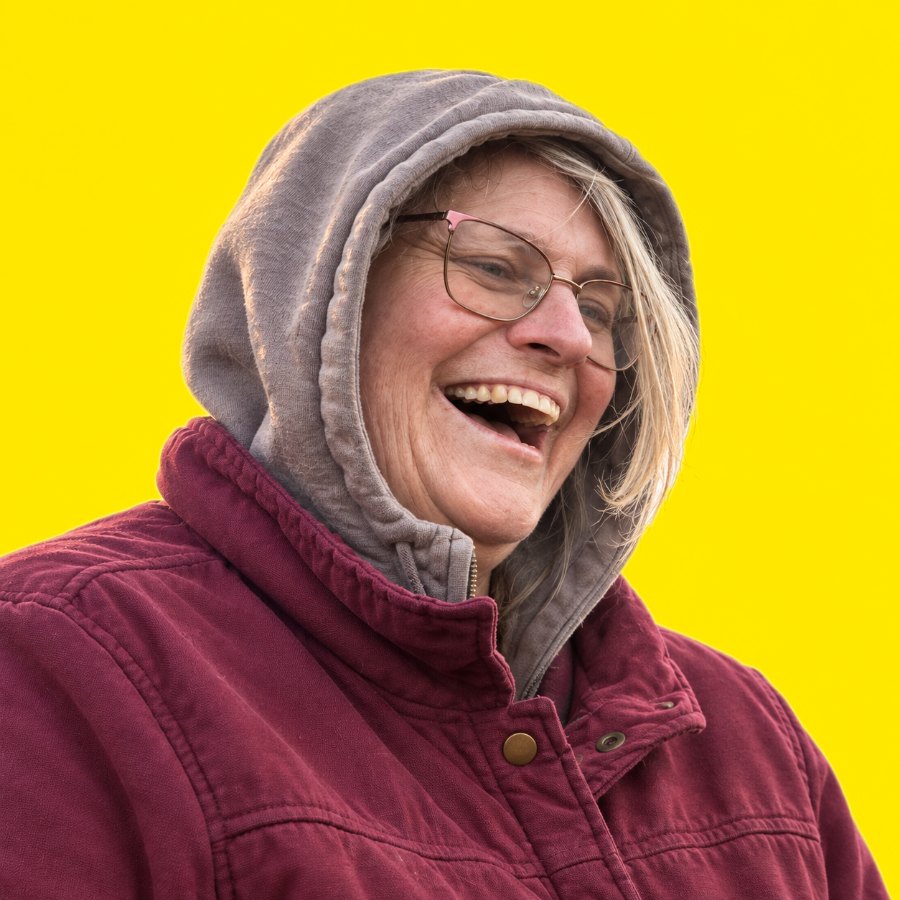
The woman across from me now wears a worn purple jacket and Crocs.
“I’m a wild mustang,” she tells me, her voice steady. “You can’t break my spirit.”
Her body has tried. Mangala lives with a chronic illness, and she speaks about it plainly, without vanity.
Meditation, she says, is how she manages it. “Otherwise I couldn’t cope with this planet.”
This is why she wakes before the sun to meditate. It isn’t a lifestyle choice. It’s anaesthesia. Then she throws her head back and laughs — a huge, uninhibited sound, the laugh of a twelve-year-old girl, and it shakes the small RV.
If I’m honest, I listen to her and I’m scared. Scared because I’m getting too inspired. Scared of joining her in this vision and losing myself in it.
I have never raised a goat. My hands are soft; they belong to a keyboard, not a milking stand. But when I step out of the RV and into the pasture, into the smell of alfalfa and earth, I’m not in California any more. I’m in Bahawalpur. I’m a child in the summer heat, knee-deep in the feed my grandmother mixed for her animals. I am thousands of miles and decades from that place, and Mangala’s land collapses the distance. She brings me home.
To understand her you have to understand the ground she stands on. The ranch has been in her family since about 1915. “My grandfather was a livestock dealer,” she says. “These houses are 150 years old. All tongue-and-groove.”
She gestures at the hills beyond the fence and her face tightens. “Petaluma wasn’t always boutiques and brunch. This was dairy and eggs — the capital of the world. We had chicken houses everywhere. We fed people.”
The egg capital is becoming luxury housing, and the farmers are being pushed out. For Mangala this isn’t nostalgia. It’s survival. “You can put houses anywhere,” she says, her voice cutting through the evening. “You can’t grow food anywhere. People want barns for aesthetics. But here, animals go in when they want. Farming is not a hobby. It’s a relationship.”
“Think what milk should cost,” she warns. Pave the pasture and we lose the ability to feed ourselves.
Relationship over extraction is how she runs the herd. In an industry that treats animals as machines, her goats live twice the usual span. “Why stress them with pregnancies every year if I don’t need to?” Everything here has a Sanskrit name. Durga, after the warrior goddess, stands guard. Vishnu is a massive buck she calls “a big puppy in a goat suit.” There is Shanti, peace, and Bhakti, devotion.
“People think farmers are rich,” she says, leaning her head against Durga. “They’re not. They do it because they love it.”
Her plan is fully costed and unsentimental: a commercial dairy making artisanal goat cheese — the paneer she already makes, soft and rich; marigolds for Indian weddings; a commercial kitchen to feed the homeless; barn apartments where volunteers can live with dignity. At the centre of it is what she calls Good Karma — a place for survivors of domestic violence and children with autism, two groups she knows have a particular connection with animals. “Women are going to heal this planet,” she tells me. “If there’s any hope, it’s women.”
She keeps telling me to listen to her teacher, whose talks play in the background of her life. “Peace is the most valuable thing in the world. Without it, you can lose everything.” I try to listen to Baba. He doesn’t bring me the calm her goats do.
For her the land isn’t a chore. It’s the meditation. “This keeps me honest.”
The volunteers who come — students from Sonoma State, locals who show up just to be near this — shovel compost, fix fences, milk the herd. They come because they want a future that has this in it: animals, spirit, kindness.
I sit in the RV eating her homemade pumpkin pie, and I worry. About the For Sale signs that could go up any day. I want to save Mangala. I want to save this farm from drifting off like the coastal fog. I want her body to heal so she can lead the sermons she dreams of, in a temple built on this land.
But I can’t build the temple. The only thing I can do is write about her dream — the wild mustang of Kuck Lane — in the hope that someone else sees what I see: a place where the land heals the people, and the people, in turn, heal the land.